Viking Oven Runs Cold: Why 350°F Is Really 305°F
A Viking oven that bakes forty to sixty degrees under its setpoint has three likely causes, and only one of them is expensive. How to measure the drift properly and read what the pattern is telling you before booking a repair.
- Written by
- Arthur Benedetti
- Experience
- 12 years
- Position
- Service technician — dishwashers and drainage
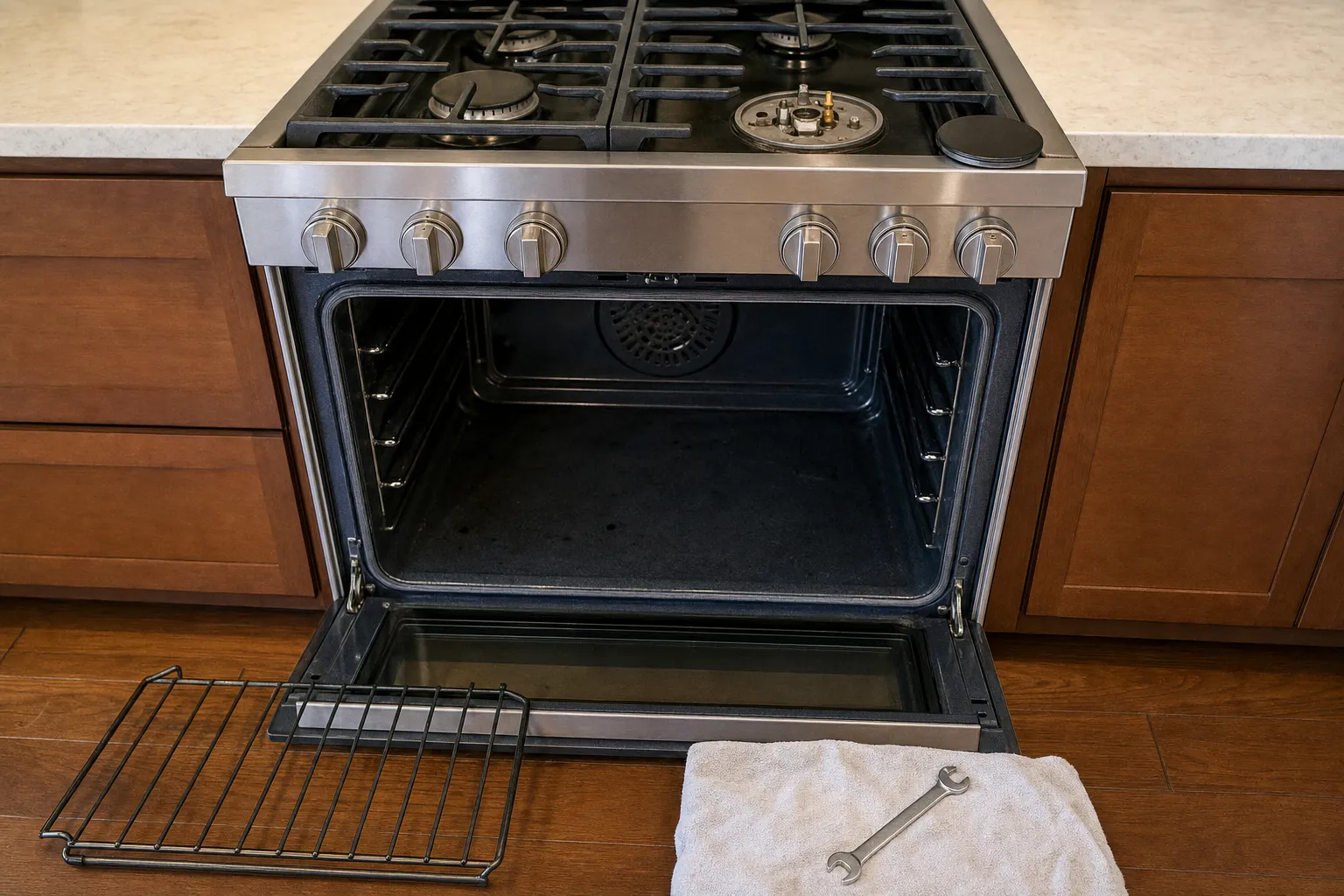
Baking is the first thing to expose an oven that runs cold. Roasting hides it — a chicken that takes ten minutes longer just looks like a bigger chicken. But cakes sink, bread refuses to spring, and cookies spread flat, and eventually somebody puts a thermometer on the middle rack and finds 305°F where the display says 350°F.
The good news is that a steady shortfall is diagnosable and usually repairable. The important part is measuring it correctly first, because the shape of the error tells you which of three faults you have.
Measure it before you conclude anything
One glance at a thermometer is not a measurement. Ovens cycle by design: the element or burner runs, the cavity overshoots slightly, the control shuts it off, the cavity coasts down, and the cycle repeats. Catch the bottom of that swing and a healthy oven looks broken.
Do it this way instead:
- Hang an oven thermometer from the centre rack, in the middle of the cavity — not against a wall, not on the floor, not near the door.
- Set 350°F and wait for the preheat signal.
- Then wait another twenty minutes. Preheat signals fire on the sensor reading, not on a genuinely stabilised cavity, and the walls have not absorbed their heat yet.
- Read the thermometer every five minutes for the next twenty and write the numbers down.
You now have a set of readings instead of an anecdote. Average them.
A swing of 15 to 25 degrees either side of 350°F is normal. An average of 330°F is mild drift. An average of 300°F to 310°F is a real fault. And readings that start close and fall further behind the longer the oven runs mean something different again — that pattern points at the sensor, not the heat source.
Cause one: the oven is simply out of calibration
Most Viking oven controls can be offset by a set number of degrees, and the factory setting is not sacred. Controls drift over years of thermal cycling, and a replacement control board sometimes arrives with a different baseline than the one it replaced.
Calibration is the right answer when the shortfall is consistent — roughly the same number of degrees off at 250°F, 350°F and 450°F — and the oven still reaches its final temperature in a reasonable time. It is the cheapest outcome and often needs no parts at all.
It is the wrong answer when the oven takes far longer than it used to reach temperature, or when the error grows the longer the oven runs. Shifting the offset in those cases papers over a failing component and the problem returns worse within months.
Cause two: a bake element or igniter losing output
On an electric or dual-fuel Viking oven, the bake element is a resistance heater. As it ages, hot spots develop and output falls. A visibly blistered, sagging or dull-in-patches element is on its way out even if it still glows.
The tell is time. An oven that used to preheat in twelve minutes and now takes thirty is not a calibration problem. It is producing less heat per minute than it should, and the control eventually gives up trying to close the gap.
On an all-gas oven the equivalent part is the igniter. Where the bake burner is lit by a glowing igniter, the igniter has to pass enough current before the gas is let through, and a tired one can glow brightly while passing too little. The burner then lights late, or on some cycles not at all: the oven that takes forever and occasionally never gets there. A glowing igniter is not proof of a good one; it has to be measured under load.
Either part is a straightforward replacement. Neither is diagnosable by eye alone with any confidence.
Cause three: the temperature sensor is lying
The oven’s thermistor is what the control believes. If the sensor reads high, the control shuts the heat off early and the cavity sits cold — while the display insists everything is at setpoint.
Sensor faults have a distinctive signature: the error grows with cavity temperature. The oven is nearly right at 250°F, twenty degrees down at 350°F, and fifty degrees down at 450°F. That progressive pattern is why the measurement step at the top of this page matters so much.
Sensors are checked by resistance at a known temperature and compared against the specification for that model. It is a quick test with the right meter and the right chart, and the part itself is inexpensive.
What this usually costs to put right
Calibration is typically labour only and often done inside the diagnostic visit. A sensor is a modest part and a short job. A bake element or igniter is a mid-range part, and access on built-in wall ovens takes longer than on a freestanding range because the unit has to come out of the cabinet.
What we would push back on is any quote that leads with a control board. Boards do fail, but they are the most expensive component in the oven and the least likely cause of a steady temperature shortfall. If nobody has measured the sensor resistance and the element or igniter current, the board is a guess with a large number attached to it.
Bring us the readings you took and the job starts halfway done.
Asked after reading this
How much temperature swing is normal in a Viking oven?
A healthy oven cycles roughly 15 to 25 degrees either side of the setpoint as the element or burner turns on and off. What matters is the average across a full cycle, not the highest or lowest number you happen to catch.
Will recalibrating fix an oven that runs sixty degrees cold?
Only if the shortfall is steady and the oven still reaches temperature eventually. Calibration shifts the whole curve; it cannot compensate for an element that no longer delivers full heat or a sensor whose readings drift as the cavity warms.
Does an oven thermometer from the supermarket give a usable reading?
Yes, if you use it properly. Hang it centre-rack, let the oven run at least twenty minutes past its preheat beep, and take several readings across a further twenty minutes rather than trusting one glance.
oventemperaturecalibrationdiagnostics